NAZARENE AMICTUS
By Elias Saint
There is a certain kind of fashion that does not ask to be understood immediately. It asks to be experienced.
Nazarene Amictus belongs to that category.
Founded by Nigerian designer Prince Iheanyi Njemanze, Nazarene Amictus approaches clothing less as seasonal product and more as an object of spiritual, historical, and artistic expression. The designer has described the brand as being deeply informed by ancient Roman dress, early Christianity, natural materials, craftsmanship, and the idea of clothing as a form of covering and protection.
The result is a vocabulary that feels deliberately removed from the speed of contemporary fashion.
There are no obvious demands for novelty. Instead, Nazarene Amictus looks backward—to antiquity, religious iconography, handmade construction and the primitive beauty of imperfect surfaces—in order to create something that feels remarkably present.
That philosophy is particularly apparent in the two looks photographed for SHADAI.
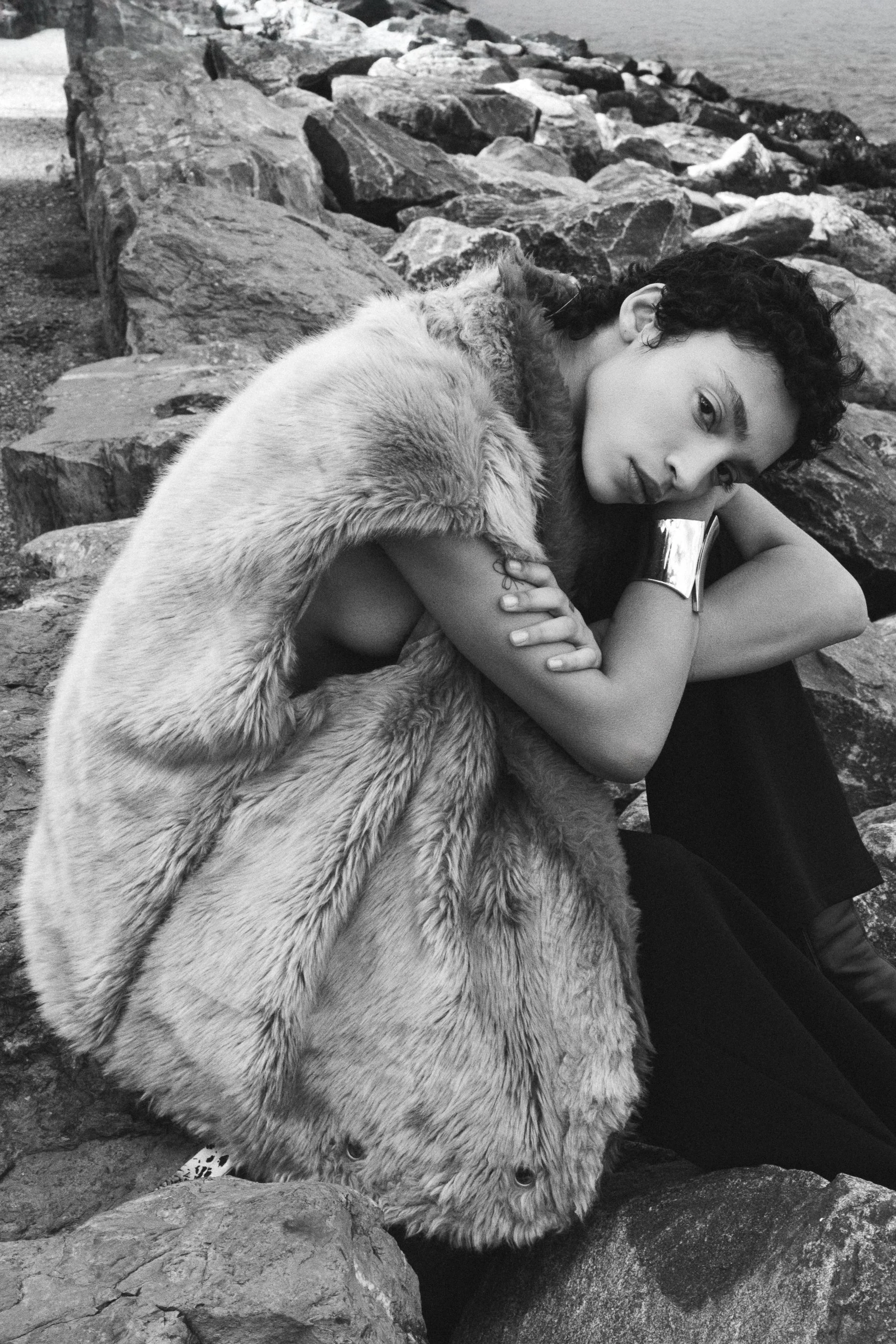
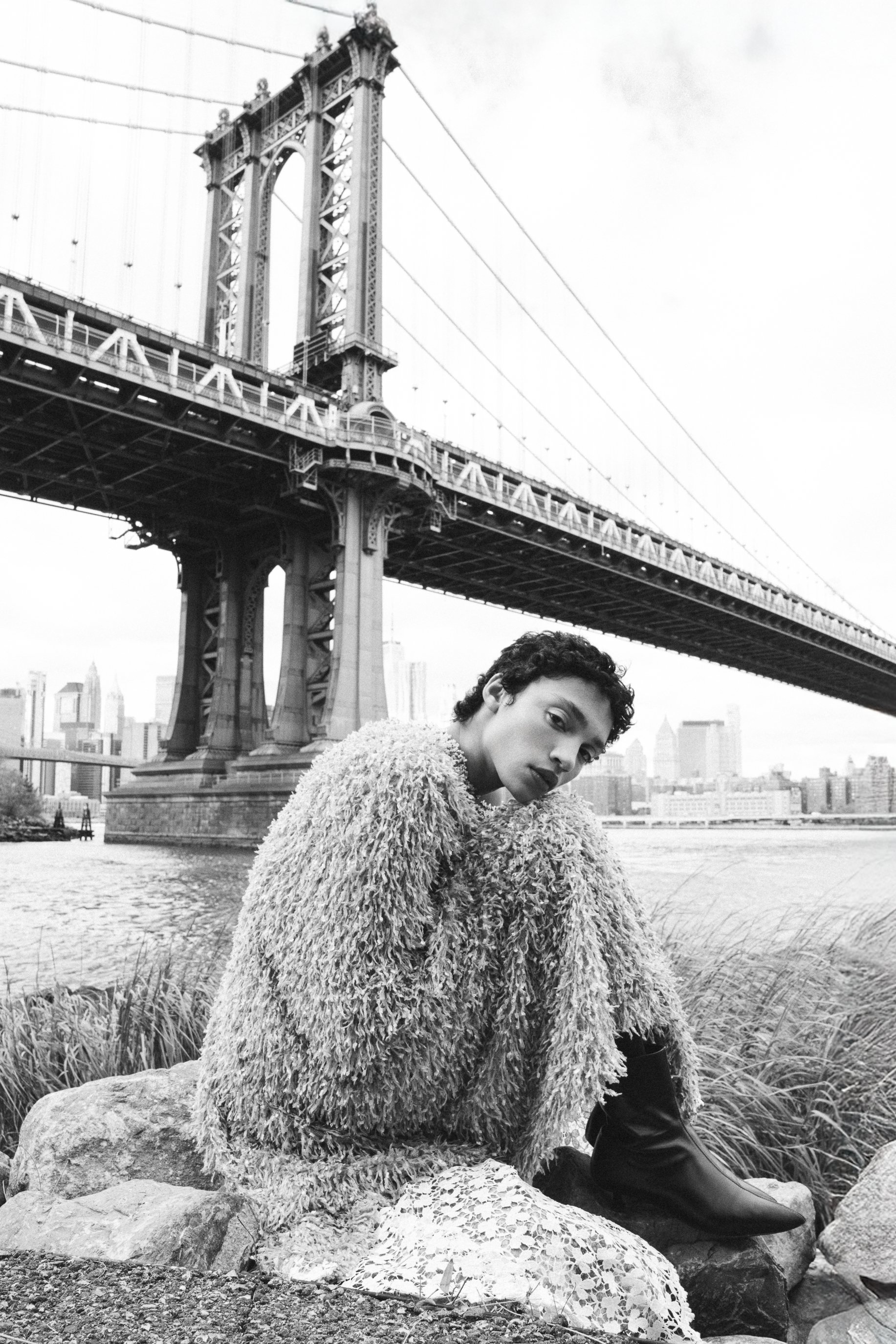
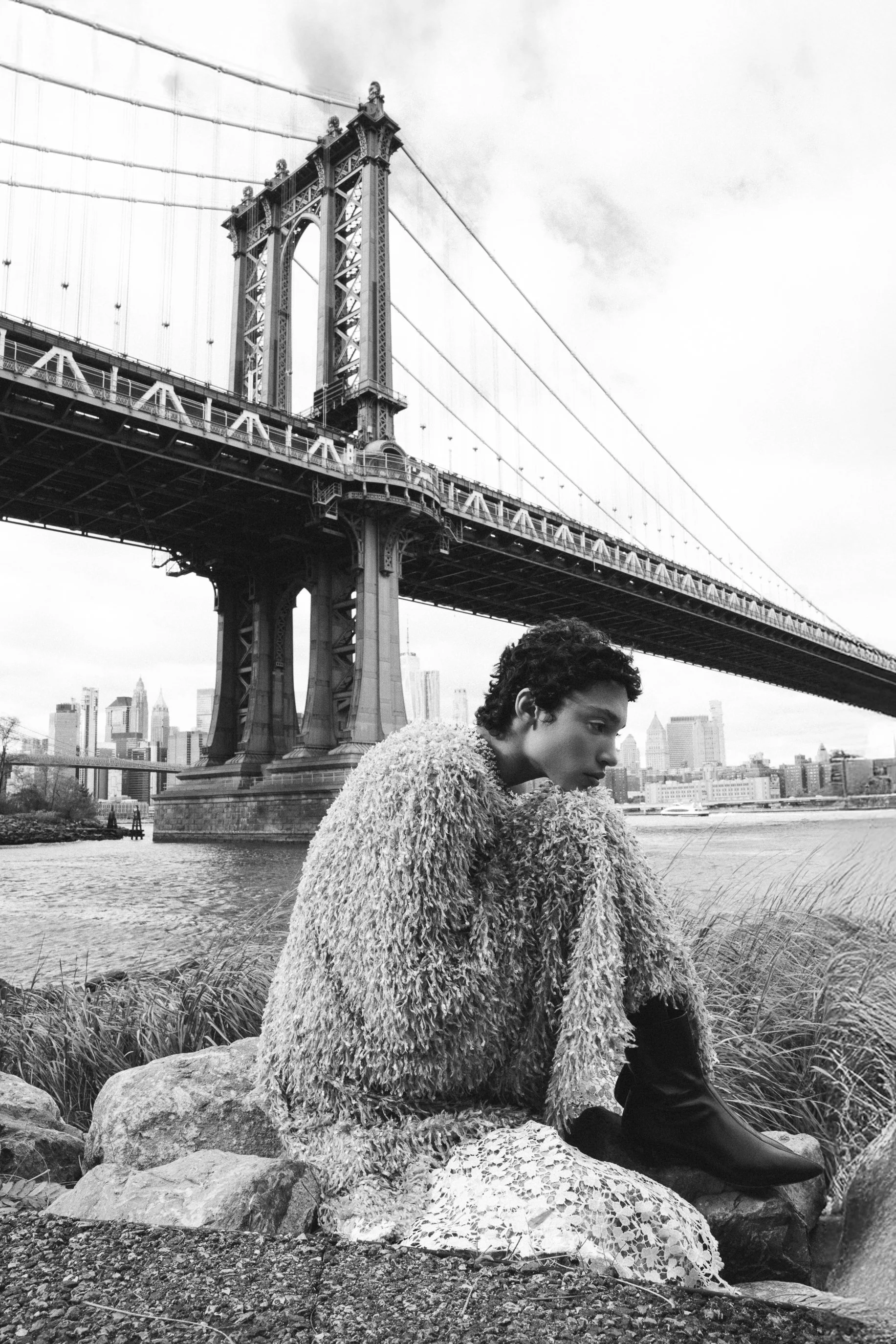
Against the monumental landscape of New York, the garments acquire an almost archaeological quality. Enormous volumes of fur-like texture envelop the body, creating silhouettes that feel simultaneously protective and ceremonial. The clothing does not merely sit upon the model; it alters her physical presence. She becomes something closer to a figure from another civilization placed temporarily within the modern city.
It is this tension that makes Nazarene Amictus compelling.
CLOTHING AS ARMOR
Njemanze has spoken openly about his belief that clothing can function as a form of spiritual armor. For him, fashion is connected to faith, gratitude and reverence, rather than simply commerce or self-presentation. He has described Nazarene Amictus as a faith-driven, biblically inspired project and himself as a vessel through which the work is created.
That conviction gives the garments an unusual gravity.
The oversized outerwear photographed here possesses the physicality of armor without resembling conventional armor. Its exaggerated texture and enveloping construction suggest protection, warmth and ritual simultaneously. The wearer appears concealed and revealed at once.
The second look, photographed beneath the Manhattan Bridge, creates an especially striking contradiction. The ancient language of the garment encounters one of the great monuments of industrial modernity. Steel, concrete, water and architecture become the backdrop for clothing inspired by civilizations that existed thousands of years before the New York skyline.
It is precisely this collision that fashion photography can make visible.
THE BEAUTY OF IMPERFECTION
Nazarene Amictus has developed its identity around limited production and an aversion to simple repetition. Earlier descriptions of the brand emphasize organic textiles, hand-finishing, irregular edges and artisanal construction, while the designer has spoken of producing collections in very limited quantities and avoiding the reuse of designs and fabrics.
That philosophy places the label closer to fashion as artifact than fashion as commodity.
There is an important distinction.
Luxury traditionally communicates value through refinement: immaculate finishing, precious materials, recognizable codes. Nazarene Amictus explores another form of luxury—the luxury of time, rarity and individuality. The hand is allowed to remain visible. Texture becomes decoration. Volume becomes architecture. Imperfection becomes evidence of the maker.
The garments therefore feel less manufactured than constructed.
A DIFFERENT KIND OF LUXURY
In an industry increasingly dominated by accelerated production and algorithmic visibility, Nazarene Amictus proposes something slower.
Its clothes are designed for the person who does not necessarily need fashion to explain itself.
There is an almost monastic confidence to the work: substantial silhouettes, muted natural textures, primitive references and an insistence upon individuality. The clothing possesses presence without relying upon excessive ornament.
This is perhaps the most interesting quality of Nazarene Amictus.
The brand does not appear interested in making the wearer fashionable in the conventional sense.
It is interested in making the wearer formidable.
And photographed against the rocks and waters of New York, beneath the immense steel geometry of the Manhattan Bridge, these garments reveal the full power of that idea. Ancient references meet contemporary architecture. Nature meets industry. Spirituality meets fashion.
The result is not nostalgia.
It is a conversation between eras.
Nazarene Amictus reminds us that fashion can still be an object of belief—that a garment can carry memory, mythology, protection and meaning long after the season that produced it has disappeared.
For SHADAI, that is precisely the kind of independent luxury worth preserving.